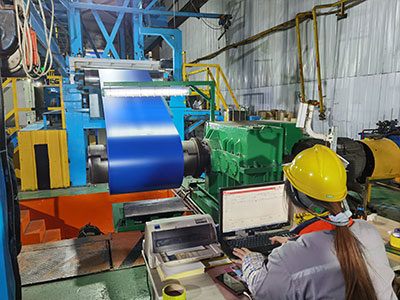
Roll forming is widely used to manufacture steel profiles with consistent cross-sections and long production lengths. In industries such as solar mounting, building construction, and industrial equipment manufacturing, Zn-Al-Mg coated steel provides an option for producing components that require both structural strength and corrosion protection.
S250GD+ZM is particularly relevant to manufacturers producing cold-formed structural profiles. However, obtaining a high-quality finished product requires more than selecting the correct steel grade. Material properties, tooling conditions, forming sequences, and dimensional control all influence the final result.
This article examines common roll-forming problems and practical ways to improve production quality when processing S250GD+ZM steel.
Roll forming involves gradually bending a continuous steel strip through a series of forming stations. Unlike press forming, the material passes through multiple rollers to achieve the required cross-sectional geometry.
For manufacturers, the incoming steel must meet several requirements:
Consistent thickness across the coil.
Stable mechanical properties.
Suitable surface quality.
Reliable coating adhesion.
Appropriate yield strength and elongation.
S250GD+ZM, specified under EN 10346, has a minimum yield strength of 250 MPa. It can be considered for structural profiles such as C channels, U channels, support rails, and other cold-formed components.
Nevertheless, a particular grade does not guarantee that every profile can be produced without adjustments. Actual formability depends on material thickness, cross-sectional design, bend radius, tooling, and production speed.
Cracking may occur when the material experiences excessive deformation at a bending location.
This is more likely when a profile has very small corner radii, complex cross-sections, or unsuitable forming sequences.
To reduce this risk, manufacturers should evaluate the minimum bend radius according to material thickness and mechanical properties. Forming deformation should be distributed across multiple stations rather than concentrated in a single operation.
Trial production is recommended before mass manufacturing complex profiles.
Zn-Al-Mg coatings provide corrosion protection, but their surface can still be damaged by improper handling or unsuitable tooling.
Potential causes include:
Dirty or damaged forming rollers.
Metal particles trapped between the rollers and steel strip.
Excessive contact pressure.
Incorrect strip alignment.
Poor coil handling and storage.
Manufacturers should regularly clean and inspect rollers, maintain appropriate forming pressure, and prevent foreign particles from entering the production line.
The objective is to maintain coating integrity while achieving the required profile dimensions.
Long structural profiles may develop twisting, bowing, or dimensional deviations during production.
These issues can result from uneven forming forces, incorrect roller alignment, inconsistent material thickness, or unsuitable forming sequences.
For solar mounting channels and other structural profiles, even relatively small dimensional deviations can affect assembly efficiency.
Manufacturers should inspect the profile at different production stages and verify straightness, flange dimensions, web width, and angular accuracy.
Springback occurs when steel partially returns toward its original shape after the forming force is removed.
The degree of springback is influenced by yield strength, thickness, bend radius, and cross-sectional geometry.
For S250GD+ZM, manufacturers should adjust roller settings according to actual material properties rather than relying entirely on settings developed for another steel grade.
Trial runs and dimensional measurements can help establish suitable forming parameters.
A systematic production approach is more effective than correcting defects after the entire batch has been manufactured.
|
Production stage |
Key control point |
Quality objective |
|---|---|---|
|
Incoming inspection |
Thickness and surface |
Consistent raw material |
|
Coil preparation |
Alignment and tension |
Stable feeding |
|
Roller setup |
Tool position and clearance |
Accurate forming |
|
Trial production |
Profile geometry |
Confirm process settings |
|
Mass production |
Periodic dimension checks |
Batch consistency |
|
Final inspection |
Straightness and appearance |
Finished-product quality |
The forming sequence should be designed according to the profile geometry. Sharp corners, narrow flanges, and complicated lips may require additional forming stations.
Lubrication, where appropriate, should also be evaluated according to the coating system and subsequent processing requirements.
S250GD+ZM can be evaluated for various cold-formed structural products.
|
Finished product |
Typical manufacturing process |
Important consideration |
|---|---|---|
|
Solar mounting C channel |
Roll forming and punching |
Hole positioning and straightness |
|
U-shaped support channel |
Roll forming and cutting |
Flange dimensions |
|
Structural purlin |
Roll forming |
Load-bearing design |
|
Mounting rail |
Roll forming and drilling |
Dimensional accuracy |
|
Customized brackets |
Cutting and bending |
Bend geometry and coating condition |
The final suitability of the material should always be confirmed through structural calculations and production trials.
For applications involving unusually complex shapes or severe bending, buyers should provide drawings and forming requirements before selecting the material.
When purchasing S250GD+ZM for roll-forming production, buyers should communicate more than the grade name.
The most useful purchasing information includes:
Material requirements: Steel grade, applicable standard, thickness, width, and coating mass.
Mechanical requirements: Yield strength, tensile strength, and elongation requirements.
Processing details: Profile drawings, bending requirements, punching positions, and cutting lengths.
Surface requirements: Oiled or non-oiled condition, surface treatment, and acceptable appearance.
Delivery requirements: Coil weight, inner diameter, packaging, and shipping destination.
Providing these details allows suppliers to evaluate whether the requested material is suitable for the intended manufacturing process.
GNEE STEEL supports manufacturers who use Zn-Al-Mg coated steel for cold-formed structural products.
We supply S250GD+ZM steel coils and can discuss customized processing solutions, including slitting, cutting, punching, bending, and roll forming.
For customers manufacturing solar mounting channels, structural profiles, and industrial support components, we can work according to technical drawings and specified dimensions.
Our objective is to help buyers coordinate raw material selection with downstream manufacturing requirements, reducing unnecessary processing difficulties and improving order consistency.
Looking for S250GD+ZM steel for roll-forming production? Send GNEE STEEL your profile drawings, thickness, coating requirements, and estimated quantity for a project-based quotation.