VR
Gnee Steel News

Pre-Coated Coil or Galvanized After Forming: What the Route Does to PV C Channel

Release Tme: 2026-10-27
Read:
Share:
Two C channels can sit side by side, measure identically, carry the same designation and still behave completely differently on site. The difference is not the section. It is when the zinc went on.

One route starts from continuously coated coil and roll-forms it into section. The other forms the section first and galvanizes it afterwards in a bath. Both are legitimate and both are widely used. They produce different coating thicknesses, different edge conditions and different mechanical properties, and a specification that says only "hot-dip galvanized C channel" does not distinguish between them.

What Each Route Actually Produces
Rolled from pre-coated coil Formed, then batch galvanized
Coating on the flats Set by the coil class — Z275 is about 20 µm per side Commonly 65–85 µm or more
Cut ends and punched holes Bare steel Covered
Coating at the folds Stretched and thinned by forming Applied after forming, so folds are uniform
Effect on strength Cold-work strength retained The bath runs near 450 °C and tempers some of the cold work
Distortion None Possible on long, light sections
Straightness and length Set by the mill Can shift in the bath
Lead time and cost Shorter, lower Longer, higher

Most high-volume PV C channel is made the first way, because the coating is uniform, the lead time is short and the cost is lower. The second way is chosen when the specification calls for edge coverage or a heavier coating than a coil class can give.

Put the two numbers side by side and the gap is plain. A pre-coated Z275 section carries roughly 20 µm per side; a batch-galvanized one commonly carries 65–85 µm. That is three to four times the thickness. It does not make the pre-coated section wrong — most PV C channel is made that way and performs well — but it does mean the two routes belong in different service environments. 

The Folds Are Where Coating Is Thinnest

When a strip is folded, the metal on the outside of the bend stretches, and the coating on it stretches with it and gets thinner. The tighter the radius relative to the thickness, the thinner the coating finishes at the corner. Push it far enough and the coating crazes.

A working rule for continuously coated material: keep the inside radius at roughly two times thickness for lighter coating classes, and around three times for heavier ones. If a drawing calls for a sharper corner than that, the corner will be the first place red rust appears, regardless of how good the coating is on the flats.

Zinc-aluminium-magnesium behaves differently here from pure zinc. It is harder — around 100–140 HV against roughly 60–80 HV for a zinc coating — so it resists handling damage and transport abrasion better, and it forms a film over an exposed cut edge. That combination is why pre-coated ZM coil has become the common choice for these sections.

Slit Edges, Punched Holes and Cut Ends

Roll forming starts from slit coil, so the strip arrives with two bare longitudinal edges running its whole length. Punching adds more: every hole and slot has a bare sheared face. Cutting to length adds two more at each end.

On a pre-coated section those edges stay bare unless something is done about them. Zinc protects them sacrificially. A ZM coating does that as well and additionally seals the edge with a corrosion-product film. Neither makes the edge equivalent to a covered one — so if the specification assumes full edge coverage, it needs to say so, or the touch-up has to be agreed in writing before production starts.

What to Check Before You Accept a Bundle
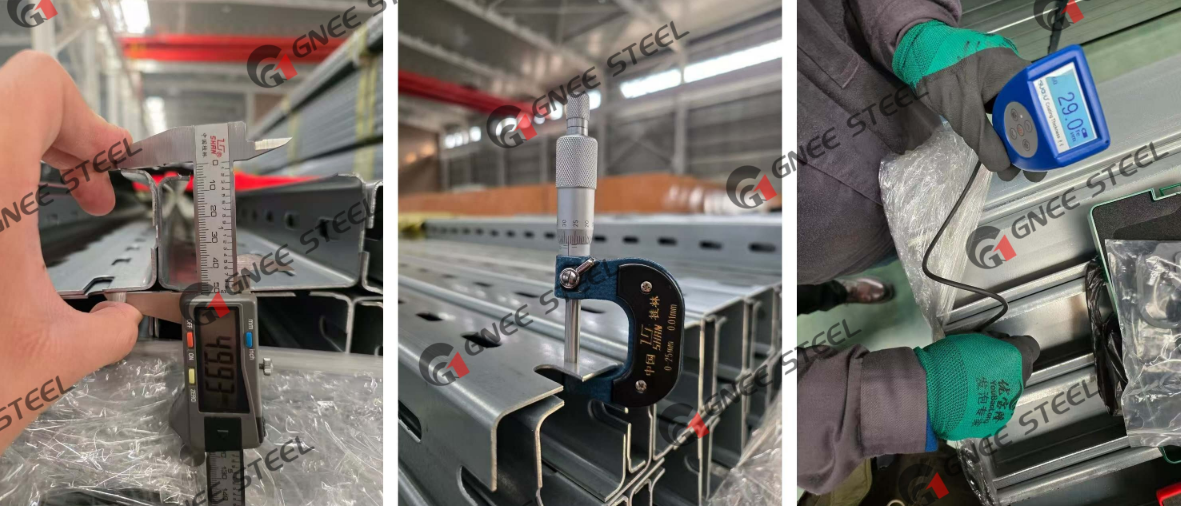
  • Measure thickness on the flat, away from the corner. Readings taken at a fold are not the thickness you bought.
  • Compare the corner radius against the drawing. This is the single most useful check on a roll-formed section, and the one most often skipped.
  • Look at slit edges, punched holes and cut ends. That is where corrosion begins.
  • Roll one length across a flat floor and watch for twist. Residual stress in cold-formed sections shows up as twist and camber on the lighter gauges.
  • Check the packing. Layers separated, bundles strapped, ends protected. Most transit damage is packing failure, not steel failure.


Frequently Asked Questions

1. Which route should I specify?
Start from the exposure and the design life. Aggressive or coastal sites with a long design life usually justify the heavier coating of a post-forming bath. High-volume standard sections for inland sites are usually better served by pre-coated coil, and the saving is significant across a full project.

2. Can you supply both?
Yes. We run pre-coated coil including Z and ZM classes, and we can arrange post-forming galvanizing where the specification requires it. Tell us the coating mass and whether edge coverage is required.

3. Can you provide coating test reports?
Yes. Coating mass is measured by weigh-strip-weigh and reported as three-spot and single-spot values, with mill test certificates traceable to the coil.
 
Related Products
Crgo silicon electrical steel sheet coil silicon steel strip
GNEE G550 Galvanized Steel Coil
DX53D Galvanized Steel Coil
PPGI Corrugated Steel Roofing Sheets
Related News
COLD ROLLED WEAR RESISTANT PLATE PICKLING
When the output of cold-rolled wear-resistant plates is more than 1 million tons/year, modern cold-rolling units with large-scale, continuous, automatic and high-speed characteristics should be adopted. To improve production efficiency, try to avoid multiple single or double machines works following reversible rolling method.
2024-02-04
Advantages of hot dip galvanizing
The advantage of hot-dip galvanizing is that it has a long anti-corrosion life and is adaptable to a wide range of environments.
2024-03-13
Large transformer made of oriented electrical steel
Grain-oriented electrical steel is a special kind of steel with good orientation. It is used to manufacture large transformers and plays an important role in nuclear power plants. In this article we will explore the use of grain-oriented electrical steel in nuclear power plants and its impact on transformer performance.
2023-11-23