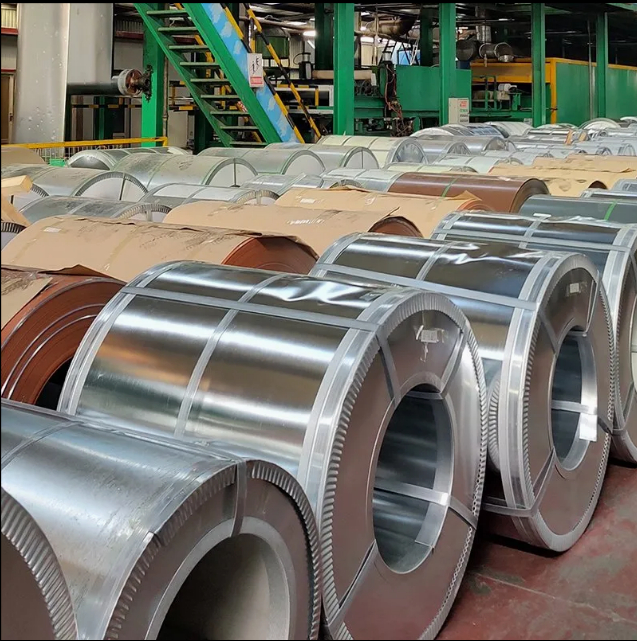
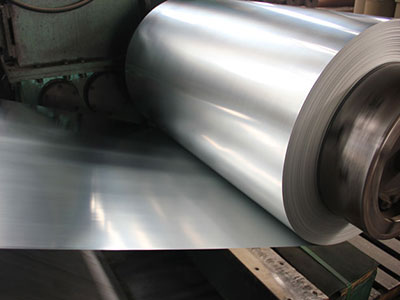
DC54D+ZM is chosen as a base grade for its extra-deep-drawing substrate and its Zn-Al-Mg corrosion protection. Once the grade is fixed, the coating weight is the specification that decides how long the part will last — and how much it will cost. Although DC54D+ZM can be produced over a wide coating-weight range, the large majority of export orders come down to three standard classes: ZM120, ZM180 and ZM275, which cover indoor service, general outdoor service and heavy-duty aggressive environments respectively. This guide explains the difference between the three and helps you pick the right one for your part.
GNEE STEEL supplies DC54D+ZM coil and sheet in ZM120, ZM180 and ZM275 as standard classes; other coating weights such as ZM100, ZM150 or ZM220 are available on request.
What Do ZM120, ZM180 and ZM275 Mean?
In the ZM designation, the number is the minimum total coating mass on both surfaces of the sheet, expressed in grams per square metre (g/m²), verified by the three-sample (triple-spot) method under EN 10346. ZM180 therefore means at least 180 g/m² of Zn-Al-Mg alloy across both sides together — nominally about 90 g/m² per side.
Because the density of the Zn-Al-Mg alloy is close to that of zinc, the coating mass can be converted into an approximate coating thickness:
| Coating class |
Minimum total mass (both surfaces) |
Approximate thickness per side |
| ZM120 |
120 g/m² |
≈ 8.5 µm |
| ZM180 |
180 g/m² |
≈ 13 µm |
| ZM275 |
275 g/m² |
≈ 20 µm |
The thickness values are indicative and depend on the actual alloy density; the contractual value is the coating mass in g/m² according to the applicable standard.
A heavier class means a thicker coating layer and a larger reservoir of zinc available for sacrificial protection — which translates directly into a longer corrosion life in the same environment.
How Coating Weight Affects Your Part
- Corrosion protection: the heavier the coating, the longer the part can be expected to serve before the coating is consumed. This matters most outdoors and in humid, coastal or industrial atmospheres.
- Cut edges and scratches: ZM coatings protect exposed steel at cut edges through their corrosion products. A heavier class extends that protection further on edges and scratches that cannot be painted.
- Forming: all three classes are designed to survive the cold forming that DC54D permits. In practice, the lighter ZM120 is the most forgiving on very tight radii and the deepest draws, while ZM275 asks for slightly more careful tooling and process control.
- Welding: heavier coatings generate somewhat more fume and wear resistance-welding electrodes faster; parameters should be adjusted accordingly.
- Cost: coating weight is one of the few variables in a coated-steel specification that directly raises material cost. There is no benefit in paying for ZM275 on a part that will spend its life in a dry indoor cabinet.
When to Choose ZM120
Choose ZM120 when the part is used indoors or in a sheltered, low-humidity environment and the coating mainly has to protect the steel against handling, condensation and occasional moisture.
ZM120 is the economical choice and the friendliest to forming. Because Zn-Al-Mg coatings already resist corrosion several times better than conventional zinc coatings of the same mass, ZM120 often delivers sufficient protection for components that would traditionally have been ordered with a much heavier galvanized coating.
Typical ZM120 applications include:
- Deep-drawn housings and internal parts for household appliances.
- Indoor electrical enclosures, meter boxes and control-cabinet components.
- Formed parts that are painted or covered by another layer after assembly.
If the part can be exposed to outdoor storage, direct rain or regular condensation, move up to ZM180.
When to Choose ZM180
Choose ZM180 when the part is used outdoors in a normal rural or suburban atmosphere, or indoors in regularly humid conditions, and a balanced combination of protection, formability and price is required.
ZM180 is the most commonly specified class for general outdoor formed steel parts. It provides a clear corrosion safety margin for profiles, housings and equipment that stand outside for years, while remaining easy to form and weld.
Typical ZM180 applications include:
- Formed building profiles, flashings, drainage and roofing accessories.
- Machine housings, outdoor cabinets and general industrial equipment.
- Agricultural and gardening equipment in moderate climates.
- Components that must survive long sea freight and open-air storage before installation.
Where salt-laden coastal air, heavy industrial pollution or chemical exposure is expected, step up to ZM275.
When to Choose ZM275
Choose ZM275 when the part faces the most demanding conditions: coastal and marine atmospheres, tropical high humidity, industrial or chemical environments, agricultural exposure, or road-salt regions — and when the design life is long or maintenance access is difficult.
ZM275 is the heaviest standard class and offers the maximum coating reservoir and the strongest cut-edge protection. It is the specification to use when premature corrosion would mean expensive replacement, safety risk or downtime.
Typical ZM275 applications include:
- Outdoor enclosures, cabinets and structural-formed parts for coastal installations.
- Agricultural equipment, livestock and dairy hardware exposed to moisture and chemicals.
- Long-life building elements and infrastructure components.
- Parts designed for 20+ years of service in aggressive environments.
For very thin substrates, confirm with your supplier that the heavier coating can be produced reliably on your gauge — a very heavy coating on very thin steel can be limited in availability.
The Three Classes at a Glance
|
ZM120 |
ZM180 |
ZM275 |
| Minimum total coating mass (both sides) |
120 g/m² |
180 g/m² |
275 g/m² |
| Approximate thickness per side |
≈ 8.5 µm |
≈ 13 µm |
≈ 20 µm |
| Typical service environment |
Dry, sheltered indoor |
Normal outdoor, humid indoor |
Coastal, industrial, agricultural, road salt |
| Corrosion protection level |
Standard |
Enhanced |
Maximum |
| Behaviour in severe deep drawing |
Best |
Good |
Acceptable — verify by trial |
| Relative material cost |
Lowest |
Moderate |
Highest |
| Typical parts |
Appliance internals, indoor enclosures |
Building profiles, machine housings, outdoor equipment |
Coastal enclosures, agricultural equipment, long-life parts |
How to Write It in Your Order
A complete specification avoids ambiguity. For example:
DC54D+ZM steel coil — Thickness 1.0 mm × Width 1250 mm — Coating ZM180 — Finish M (minimized spangle) — Surface treatment: chromate-free passivation and oiling (C+O) — Standard EN 10346
Always state the standard you require (EN 10346, or the equivalent ASTM A1046/A1046M or JIS G 3323), the coating class, the finish and the surface treatment. The coating mass is verified against the standard's triple-spot and single-spot test requirements and is documented in the mill test certificate.
A Simple Selection Rule
If you are not sure where to start:
- Parts that stay indoors → ZM120.
- Parts that live outdoors in a normal climate → ZM180.
- Parts exposed to coastal, industrial, agricultural or road-salt conditions, or designed for very long life → ZM275.
Where the forming is unusually severe and the environment aggressive, confirm the combination with a prototype draw or bend test on the exact coating class before committing to serial production.
DC54D+ZM Coating Classes from GNEE STEEL
GNEE STEEL supplies DC54D+ZM in ZM120, ZM180 and ZM275 as coil, slit strip and cut-to-length sheet, with the surface finish and treatment your process requires and full mill test documentation. If you are unsure which class fits your application, send us the part description, the service environment, the target design life and the forming process — our technical team will recommend a coating class and confirm availability with a professional quotation.