On a bright morning at GNEE STEEL’s production facility, our team had the pleasure of hosting a group of valued international clients for an exclusive factory tour focused on our flagship galvanized steel grating products. This immersive visit was designed to give clients a transparent, hands-on look at every stage of our production process—from raw material selection to rigorous quality testing—reaffirming our commitment to delivering high-performance, corrosion-resistant steel solutions that meet global industry standards. The day’s activities included in-depth discussions, sample inspections, live production demonstrations, and precision quality checks, creating a collaborative experience that strengthened trust and alignment on project requirements.
The tour began with a warm welcome and an overview of GNEE STEEL’s legacy in manufacturing industrial steel products, highlighting our 15+ years of expertise in galvanized steel grating production and our dedication to innovation and quality control. Clients were briefed on the diverse applications of our steel gratings, which serve critical roles across industries including oil and gas, wastewater treatment plants, power generation facilities, construction platforms, and transportation infrastructure. Unlike generic steel products, our gratings are engineered for superior load-bearing capacity, slip resistance, and long-term durability—qualities that were brought to life through the day’s demonstrations and inspections.
.png)
Moving into the factory’s sample showroom, clients were invited to examine a comprehensive range of galvanized steel grating samples, each tailored to different project specifications and environmental conditions. Our technical team walked them through key product variations, including different bar spacings, bearing bar thicknesses, and surface finishes, explaining how each design choice impacts performance. For example, wider bar spacing is ideal for drainage applications, while closer spacing provides enhanced safety for pedestrian platforms. Clients were particularly impressed by the uniformity of the hot-dip galvanized coating across all samples, a visual testament to our precise surface treatment processes. They took time to run their hands over the grating surfaces, inspect weld joints, and compare the finish of standard vs. heavy-duty galvanized options, asking detailed questions about customization possibilities for their specific projects.
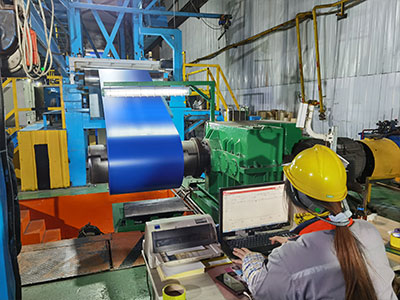
Next, the tour proceeded to the production floor, where clients witnessed the step-by-step manufacturing process of our galvanized steel gratings, from raw steel preparation to final packaging. The journey began with the arrival of high-grade Q235B carbon steel coils, which are first cut into bearing bars and cross bars using automated precision cutting machines. Our team explained that every piece of steel is sourced from certified mills, with full material traceability to ensure compliance with ASTM, ISO, and EN standards. The cut bars then move to our high-pressure resistance welding stations, where advanced machinery fuses bearing bars and cross bars into a rigid, interlocking structure. Unlike manual welding, this automated process creates strong, consistent welds that eliminate weak points and ensure uniform load distribution across the grating. Clients watched closely as finished gratings emerged from the welding line, noting the clean, smooth welds that are critical to both structural integrity and corrosion protection.
The most anticipated stop on the production tour was the hot-dip galvanizing line, where raw steel gratings undergo a multi-step surface treatment process to achieve exceptional corrosion resistance. Our team explained the galvanizing process in detail: first, the gratings are degreased to remove surface contaminants, then pickled in acid to eliminate rust and scale, followed by fluxing to prepare the steel for zinc adhesion. Finally, the gratings are immersed in a bath of molten zinc at approximately 450°C, where a chemical reaction forms a metallurgically bonded zinc-iron alloy layer. This layer is not just a surface coating—it becomes an integral part of the steel, providing both barrier protection and cathodic protection against corrosion. Clients were able to see freshly galvanized gratings being lifted from the zinc bath, with the bright, silvery finish characteristic of high-quality hot-dip galvanizing. Our team emphasized that the entire process is closely monitored to ensure consistent coating thickness, which directly impacts the product’s service life in harsh environments.
.png)
A highlight of the day was the live quality testing demonstration, where our quality control specialists used advanced equipment to verify the performance of the finished galvanized steel gratings. The centerpiece of this demonstration was the use of a Fischer DualScope MP0 coating thickness gauge, a state-of-the-art instrument that provides non-destructive, precise measurements of zinc coating thickness. Clients watched as our technician carefully placed the gauge on the surface of a finished grating, with the display immediately showing a coating thickness reading of 56.27 microns, alongside statistical data including average (94.31 μm) and standard deviation (58.96 μm). Our team explained that we require zinc coating thickness to meet or exceed 85 microns (in line with GB/T 13912-2021 standards) for standard applications, with heavy-duty options available for more corrosive environments. The clients were impressed by the precision of the measurement and the transparency of our testing process, asking questions about how we ensure coating uniformity across large batches of gratings. Our specialists explained that we conduct random sampling from every production run, with multiple measurements taken across different areas of each grating to confirm compliance with specifications.
In addition to coating thickness testing, clients were shown other key quality checks, including visual inspection for surface defects (such as bare spots, drips, or uneven zinc buildup), weld strength testing, and dimensional accuracy verification. Our team demonstrated how we use calipers and measuring tapes to confirm that grating dimensions meet the exact tolerances specified by clients, ensuring a perfect fit during installation. They also explained that every batch of gratings is accompanied by a detailed quality control report, including material test certificates (MTCs), coating thickness results, and compliance documentation, providing clients with full peace of mind about the quality of their order.
Following the factory tour, the GNEE STEEL team and clients gathered in our conference room for a detailed discussion about project requirements, technical specifications, and delivery timelines. Clients shared insights into their upcoming projects, including a wastewater treatment plant expansion and an industrial platform upgrade, and our technical team provided tailored recommendations for grating designs, coatings, and installation methods. The collaborative atmosphere allowed for open dialogue, with clients asking follow-up questions about maintenance requirements, lead times, and customization options. Our sales team reassured clients that we offer flexible production schedules to meet tight project deadlines, with the capacity to produce over 500 tons of galvanized steel gratings per month. The meeting also included a discussion of our after-sales support services, including installation guidance and long-term product warranties, further demonstrating our commitment to being a reliable partner throughout the entire project lifecycle.
As the day drew to a close, clients expressed their appreciation for the comprehensive tour and the opportunity to see GNEE STEEL’s manufacturing capabilities firsthand. Many noted that the transparency of the process—from raw material sourcing to final quality testing—had exceeded their expectations, reinforcing their confidence in our ability to deliver high-quality products. They highlighted the professionalism of our team, the precision of our equipment, and the attention to detail in every step of the production process as key takeaways from the visit. Several clients even expressed interest in placing initial orders following the tour, citing the direct experience with our quality control measures as a major factor in their decision-making.
.png)